The fastest way to calm classrooms is to standardize 5 Tier-1 routines and a de-escalation flowchart with precise teacher language.
Why Tier-1 beats endless consequences
Routines create predictability; predictability lowers cognitive load and conflict.
Tier-1 Classroom Routines — Quick Reference
| Routine |
When |
Teacher Script |
Student Signal |
Evidence |
| Entry routine |
Bell |
“Track the Do Now. Start timer.” |
Eyes on board, pencils up |
90% on task in 60s |
| Attention signal |
Any transition |
“Give me five—5, 4, 3, 2, 1.” |
Voice off, eyes front |
Transitions ≤ 10s |
| Positive scan |
Every 2–3 min |
“I see 3 tables on task—thank you, Table B.” |
Heads down, writing |
On-task notes |
| Re-direction |
Off-task |
“Pause. Direction once. You’ve got this.” |
Student resumes work |
1 redirection only |
| Exit routine |
Last 3 min |
“Circle Q3. Hand to row leader.” |
Work submitted |
95% collection |
Rule of thumb: One public redirection only. Then move private.
De‑Escalation If/Then Flowchart
Use thresholds to match the response to the behavior. Keep voice neutral; reduce audience; give bounded choices.
Low‑level
Refusal
Escalation
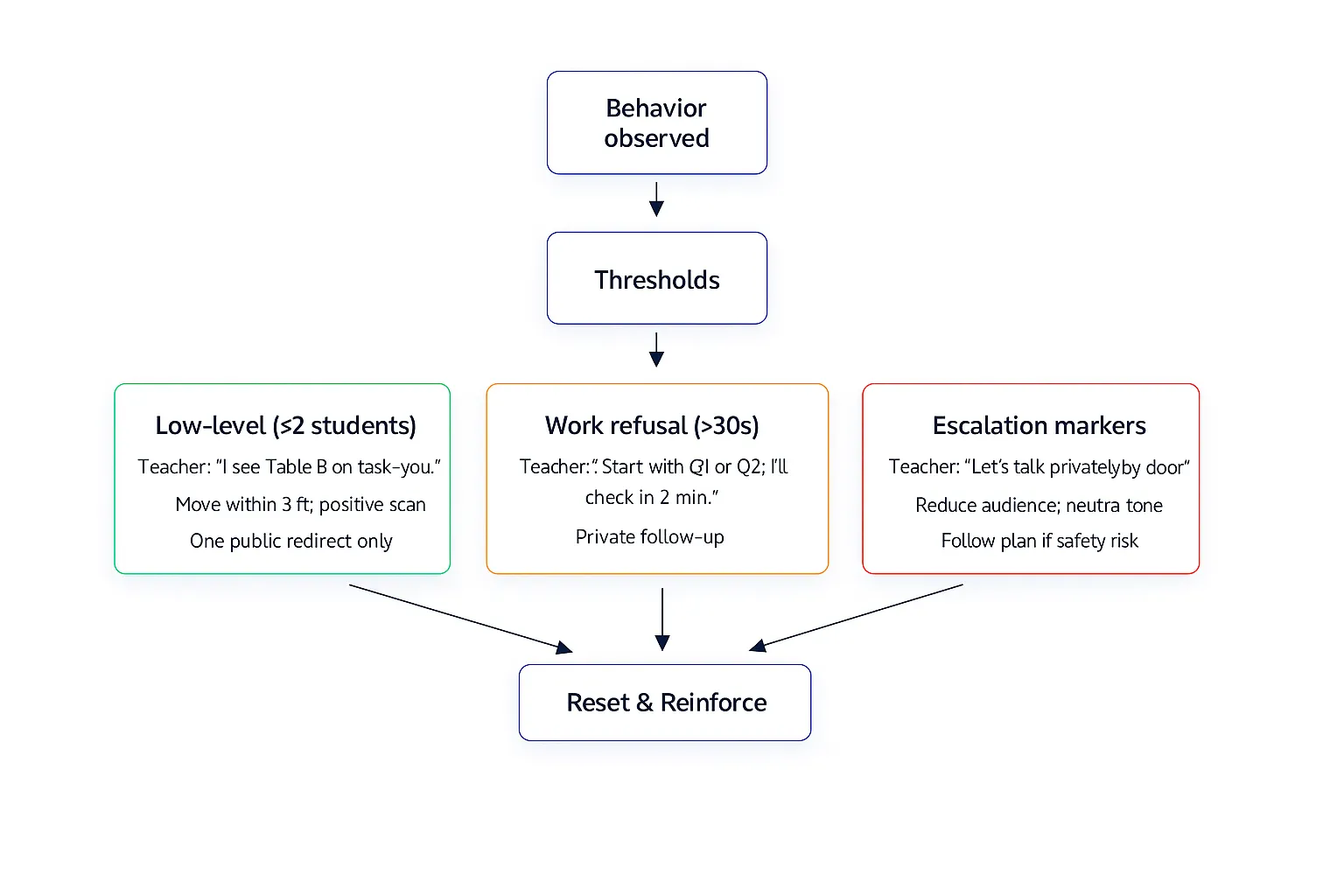 Public → Private • Group → 1:1 • Choice → Boundaries
Scripts Library (Do / Don’t)
Work refusal (>30s)
- Do: “Start with just the heading. I’ll check back in 2 minutes.”
- Don’t: “This is easy.”
Low‑level disruption (≤2 students)
- Do: “I see three tables tracking—thank you, Table B.”
- Don’t: “Why aren’t you listening?”
Escalation markers (volume ↑, posture rigid)
- Do: “Let’s talk privately by the door.”
- Don’t: “Calm down.”
Coaching Cycle & Look‑Fors
- Plan: Pick 1 routine + metric.
- Model/Co‑teach: Coach holds timer and tallies.
- Feedback: “2 glows, 1 grow” tied to the metric.
- Measure: ODR per 100 students weekly; transition averages.
Coaching Cycle & Look‑Fors
- Plan: Pick 1 routine + metric.
- Model/Co‑teach: Coach holds timer and tallies.
- Feedback: “2 glows, 1 grow” tied to the metric.
- Measure: ODR per 100 students weekly; transition averages.
What to Measure
- Transition time: Seconds from attention signal to 95% materials out (avg of 3/day).
- Redirections per lesson: Count public then private; aim ≤ 3.
- On‑task @ 60s: % of students visibly working one minute after start.
- ODR rate: Office discipline referrals per 100 students per week.
FAQ
What are Tier‑1 behavior supports?
Universal routines and responses used by every teacher, every day, to prevent and reduce low‑level disruption.
How do I measure transition time?
Start the timer at the attention signal and stop when 95% have materials out; average 3 transitions per day.
What if a student refuses to start?
Offer a bounded choice (Q1 or Q2), reduce the audience, and follow up privately within 2 minutes.
How long does rollout take?
Most schools can standardize five routines and de‑escalation scripts within 30 days.
Ready to learn more? Visit SOLVED Consulting today and discover solutions to support your school’s growth and success.



.webp)