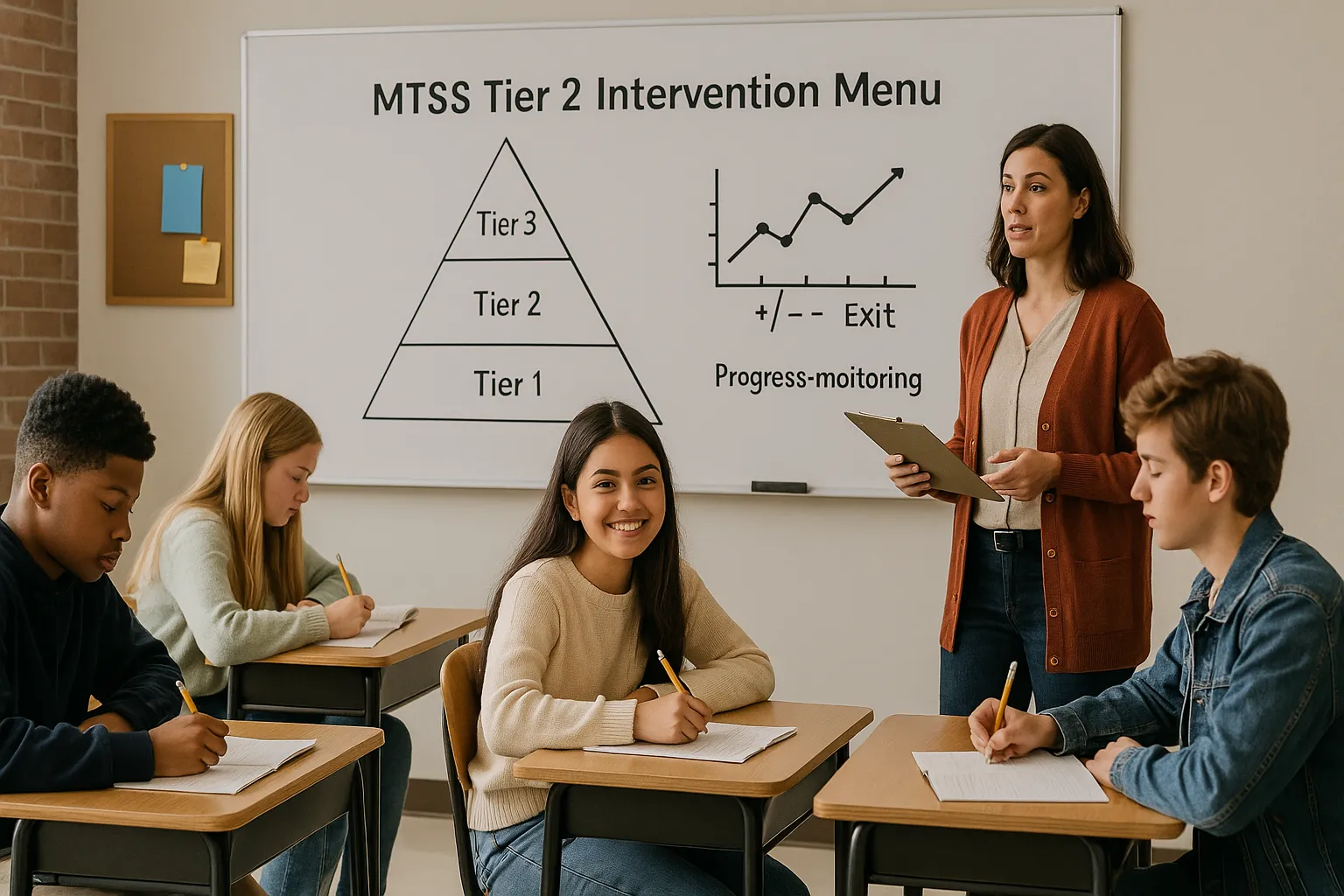
MTSS Tier-2 Intervention Menu + Progress-Monitoring Templates (Free Guide)
6
minute read
|
November 2025
| Last updated:
Turn scattered Tier-2 supports into a small, high-fidelity menu with clear entry/exit rules, weekly progress monitoring, and 4-week decision cycles your team can actually run.
Tier-2 in Plain English
Tier-2 supports are targeted, short-term interventions for students who aren’t making progress with strong Tier-1 instruction alone.
Schools often struggle not because Tier-2 doesn’t work—but because the systems around it (entry/exit rules, routines, monitoring, fidelity) aren’t clearly defined.
This guide gives you:
A simple Tier-2 menu (academic + behavior)
Clear entry and exit rules anyone can implement
Weekly progress-monitoring routines
A 4-week intervention cycle that moves data
Practical examples your teachers can follow tomorrow
If you need support implementing MTSS or want tailored Tier-2 systems for your school, you can reach out to our team anytime through our
Contact page—we’ll help you set up your first cycle with confidence.
Tier-2 in one sentence: Targeted, small-group or check-in support for students who need more than Tier-1, delivered on a predictable routine and tracked weekly.
Tier-2 Entry & Exit Rules (Copy-Ready)
Clear decision rules keep Tier-2 from turning into a parking lot. Use these as a starting point and adapt to your context.
Enter Tier-2 if…
Academics: Below benchmark for 3 consecutive probes.
Behavior:2+ ODRs in 4 weeks for the same behavior.
Teacher referral: With classroom data and evidence.
Exit Tier-2 when…
4 consecutive points are on/above the aimline, and
Teacher notes show independent use of the skill.
Adjust, don’t drift: If progress is flat or declining for 2–3 weeks, tighten dosage, switch the intervention type, or consider Tier-3 if there’s still no growth.
Tier-2 Intervention Menu (Starter Set)
Keep your menu small and high-fidelity. Here’s a starter set you can run with existing staff and schedules.
Academic Tier-2 Interventions
Fluency Sprints (Reading or Math): 10-minute daily timings, partner accuracy checks, and weekly graphs of words correct or digits correct.
Fix-Up Mini Lessons (Comprehension): Model the strategy, practice with sentence frames, then move to independent application on short texts.
Morphology Club (Vocabulary): Teach 3 high-utility roots per week with quick practice and a Friday check.
Goal Setting & Self-Monitoring: Students track progress in simple logs and meet briefly weekly to review goals.
Behavior Tier-2 Interventions
Check-In / Check-Out (CICO): Morning check-in with a mentor, point card scored each period, afternoon check-out, and family signature.
“Breaks Are OK” Routine: Pre-taught, specific break options with a timed calm-down routine and visual card/pass.
Choice & Task Chunking: Students choose between two tasks, and work is broken into 5–7-minute chunks with a visual timer.
Social Problem-Solving Group: Weekly small group using scripted role-plays and sentence stems to practice conflict-resolution skills.
Pro tip: Fewer interventions, done well, beat a giant menu with low fidelity every time.
Progress-Monitoring Tools & Routines
Tier-2 should always run with a simple, predictable monitoring routine. No dashboards required—a graph, a goal, and a weekly check are enough to start.
Weekly Academic Monitoring
Use a brief CBM/Acadience-style probe on the targeted skill.
Graph the score with an aimline toward the end-of-cycle goal.
Add a one- to two-sentence teacher note on context or fidelity.
Behavior Monitoring
Track CICO daily points and percent of days meeting goal.
Graph ODRs per week by location or period to spot patterns.
Log brief notes when routines are changed or disrupted.
What to Include on an Exit Form
Student goal and targeted skill.
Summary graph of 4+ weeks of data.
Teacher and family comments.
Decision: keep, adjust, or exit.
The 4-Week MTSS Tier-2 Cycle
A short, tight cycle helps your team avoid “set and forget” interventions. Use this 4-week rhythm as your default.
Week 1
Baseline & Teach the Routine
Collect 3 baseline data points, teach expectations and intervention steps, and lock in the weekly monitoring schedule.
Weeks 2–3
Run the Intervention
Deliver the intervention consistently, monitor weekly, and tweak dosage or routines quickly if graphs are flat.
Week 4
Decision Meeting
Use the graph, notes, and exit form to decide whether to keep, adjust, or exit the intervention for each student.
Want a partner for this step? If you’d rather have an expert design your first Tier-2 cycle and train your staff to run it with fidelity, our MTSS coaching and setup work can walk your team through the process.
Case Example: Behavior Tier-2 in Action
A 7th-grader with frequent call-outs begins CICO plus a structured choice of first task.
Days meeting behavior goal rise from 20% to 70%.
ODRs drop from 3 per month to 1.
Teacher notes describe improved self-regulation and fewer disruptions.
The power here isn’t a fancy program—it’s a predictable routine, adult connection, and simple data used to adjust support.
Family Communication (Simple & Consistent)
Families don’t need long reports. They need a plain-language explanation of what’s happening and how their child is doing.
Welcome Message
What the intervention is and the skill it targets.
Why their child is participating (framed positively).
How they can encourage or mirror routines at home.
Weekly Update
Two-sentence progress summary.
A simple percentage or graph snippet.
Optional short note from the student or mentor.
Tier-2 FAQ
How many students should be in a Tier-2 group?
Typically 3–8 students, grouped by similar skill needs so the instruction can be targeted and efficient.
How long does a Tier-2 intervention last?
Most Tier-2 cycles run for 4–6 weeks with weekly progress monitoring and a decision meeting at the end.
What if a student isn’t improving?
Check fidelity first—is the intervention happening as planned, with the right frequency? If data are still flat, swap the strategy, increase intensity, or consider Tier-3 support.
Can Tier-2 happen during core instruction?
Yes. Many schools use station rotations or a 10-minute daily routine embedded within Tier-1 instruction to deliver Tier-2 supports without adding extra periods.
What counts as progress in Tier-2?
A rising progress-monitoring graph with most points on or above the aimline, plus classroom evidence like stronger work samples, fewer ODRs, and more independent use of the skill.
Conclusion: Build Tier-2 That Moves Data
Effective Tier-2 systems are built on clarity, routine, and weekly feedback—not a huge menu of disconnected programs.
With clear entry and exit rules, a small intervention menu, and consistent progress monitoring, schools can reduce ODRs and improve academic outcomes without adding staff or extra periods.
Start small, protect fidelity, and use your graphs to drive decisions. Once your first cycle is running smoothly, you can layer in more tools and supports.