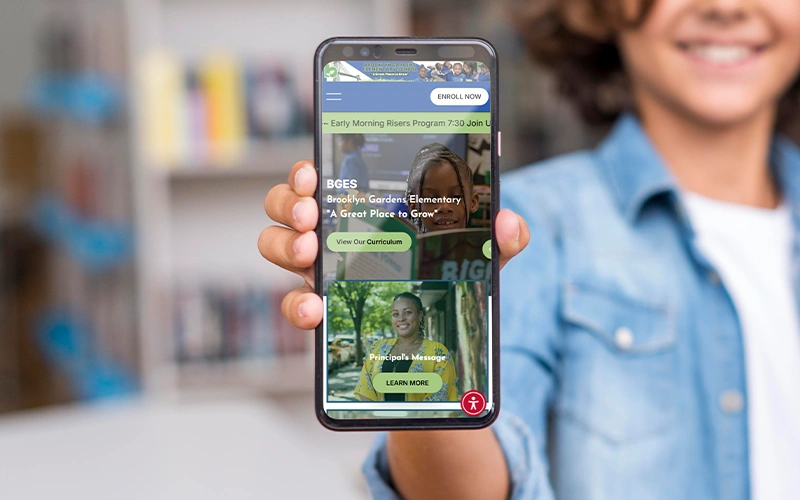
When you think of school branding, you might picture logos on letterheads or mascots on sports jerseys. But in the digital age, a school’s brand identity needs to shine through on its website and mobile app too. In this post, we’ll explore how to apply effective branding and design to your school’s digital tools. Even if you’re not a design expert, understanding the basics of consistent branding can dramatically improve your website’s impact and your app’s user experience. A strong brand presence online isn’t just about aesthetics – it builds trust and school pride. Let’s dive into Branding & Design for school websites and apps.
What Does “School Brand” Really Mean?
Your school’s brand is essentially its identity and reputation distilled into visual and verbal cues. It’s who you are and how you’re perceived. Key elements of a school brand include:
Visual Identity: Logo, colors, typography, and imagery style. For example, a school might have a crest or mascot logo, official school colors (say blue and silver), and specific fonts it uses in materials. All these should create a cohesive look that people recognize as you.
Messaging and Tone: The motto or tagline, the mission statement, and the tone of communications. Is your school’s voice traditional and authoritative, or friendly and innovative?
Some schools use a tagline like “Inspiring Excellence” – that message should resonate in the content and phrasing on the site/app.
Values and Culture: What does your school stand for? Community service, academic rigor, faith, diversity? Your brand should reflect those core values in both content and design choices. For instance, a Quaker school might emphasize simplicity and community on its website imagery and language, aligning with its ethos.
In short, branding is about creating a unified and distinct identity that sets your school apart and makes it memorable. A strong brand helps differentiate your school in a competitive landscape and increases recognition among parents and the community.
Why Branding Your Website and App Matters
Consider your website the front door to your school for the online world – often it’s the first impression for prospective families. If someone lands on your site and it looks generic or inconsistent, it can subconsciously signal a lack of professionalism or pride. On the flip side, a well-branded site instantly communicates “this is who we are.” It gives a sense of the school’s personality and quality before the visitor even reads a word.
Here are some key benefits of strong branding in your digital tools:
Increased Recognition and Trust: When all elements – from logo to colors to tone – are consistent, people start to recognize and trust the brand faster. If a parent has seen your logo on a flyer and then visits your site which uses the same logo, colors, and motto prominently, it reinforces that they’re in the right place. Consistency across materials (print and digital) conveys professionalism and reliability. As Finalsite notes, consistency in branding helps your school look established and easier to trust.
Differentiation: A unique brand identity makes your site/app stand out from other schools’. Rather than a cookie-cutter template, your site should feel like your school. Are you an arts-focused academy? Then the visuals and content should ooze creativity (maybe showcasing student art and a colorful palette). A strong brand identity helps “differentiate from other institutions in a competitive educational landscape”, attracting families who align with your values and style.
School Pride and Engagement: Branding isn’t just outward-facing; it impacts your internal community too. When students, staff, and parents see a beautiful website that reflects their school, it boosts pride. Featuring the school colors, motto, and photos of actual students creates a sense of belonging. A strong brand identity “fosters a sense of community and school spirit, leading to improved performance and culture”. For example, if your app uses the mascot image and school colors on its splash screen, students feel it’s their app, not some generic tool.
Communication of Values: Through design and content, branding communicates intangible aspects like atmosphere and values. Is your school nurturing and fun? Sleek and academically rigorous? A website’s design elements (like warm images, or bold modern graphics) convey these. As one branding agency puts it, branding creates an identity that resonates with students and parents and reflects your values, mission, and culture. In practical terms, a Catholic school might integrate subtle religious symbols or its motto on faith, immediately signaling its value system to visitors.
In summary, investing effort in branding your digital presence pays off in recognition, trust, differentiation, and community cohesion. Now, let’s get practical on how to do it.
Applying Visual Identity to Websites
Logo Placement and Usage: Your school logo (or crest/mascot) should feature prominently on the website – usually top-left of the header on each page. Ensure it’s high-resolution and not distorted by wrong dimensions. Clicking the logo should typically take users back to the home page (common web practice). Also use the logo elsewhere as appropriate: perhaps as a watermark background on the footer or on certain graphics. Maintain consistent use – don’t use old versions or different colors of it randomly. If your logo has multiple approved versions (say a full crest and a simplified icon), stick to guidelines on where each is used.
School Colors and Typography: The site’s color scheme should revolve around your official colors. For instance, if navy blue and gold are your colors, use navy for headers or the main menu background, and gold for accents like buttons or links. Don’t suddenly have a lime-green section that has nothing to do with your palette. Consistency in color not only looks professional but reinforces your brand subconsciously. Same with fonts: if your print materials use a certain font family, try to use similar (web-safe) fonts on the site. Many schools choose a clean, legible font for body text and maybe a more stylized one for headings that matches their branding. There are plenty of free Google Fonts to choose from that can match most brand styles. The key is to limit the number of fonts and colors to a cohesive set, giving every page a unified feel.
Imagery and Graphics: Use photos and graphics that align with your brand persona. If your brand is all about innovation and technology, then photos of students coding, using makerspaces, etc., fit well – and perhaps more sleek, modern graphic elements. If your brand emphasizes tradition and history, you might show legacy images or use a classic design motif on the site (like heraldic borders or serif typography). Also, treat photos with similar filters or styles if possible, so they feel part of the same family. For example, some schools use slightly desaturated, soft-tone photos to evoke a warm, nostalgic feel; others use high-contrast vibrant photos for energy. These choices should match what you want people to feel about your school.
Consistent Layout and Elements: Branding in web design isn’t just about colors and logos, it’s also about consistent design elements. If you have a signature shape or pattern (maybe your logo has a circular motif, or a wave), incorporate that in the design. Maybe section headers are inside a shape that echoes your logo’s shape. Or you use a specific icon style throughout (like all line icons or all filled icons, not mixed). These details create a polished, branded look. Also, keep navigation and page layouts consistent. Perhaps all pages start with a banner image that has an overlay of your school motto in a standard style – that immediately brands each page as part of your site.
Showcase Your Tagline/Mission: Find a spot on the homepage (and perhaps footer or about page) for your tagline or mission statement. For instance, a banner that says “Educating Girls to Lead and Serve – Since 1920” or “Excellence in a Caring Community.” Displaying this prominently in your brand font with your colors powerfully communicates your ethos. It’s part of branding because it unites the visual with the verbal message. A cohesive brand identity combines visuals and messaging consistently.
Branding Your School’s Mobile App
If your school has a mobile app for parents/students, branding it is just as crucial:
App Icon and Name: Your app icon should ideally be your school logo or a simplified version of it (perhaps just the mascot head or initials) in your school colors. This way, every time a user glances at the app on their phone, they see your brand. Keep the app name clear and branded too (e.g., “Greenwood School App” with maybe your logo in the icon).
Splash Screen: When the app launches, show a splash screen with your logo, school name, and maybe motto. It’s a good opportunity to reinforce brand each time the app opens. Use your colors for the background or elements. This mimics how many university apps open with the university shield/logo proudly displayed.
Color Scheme and UI Elements: Just like the website, set the app’s theme colors to your palette. For example, navigation bars in your primary color, accent buttons in your secondary color, etc. If your app is built with a platform that allows customization, load in your brand’s hex color codes. The goal is for the app to feel like an extension of your website (and school). A parent should not feel a jarring shift when they go from your mobile-responsive website to the app – it should feel like the same school’s digital environment.
Typography and Icons: Use your brand fonts if possible in the app (some app builders limit font choices, but choose the closest match). Maintain consistency in icon style – if your website uses line icons for, say, phone and email, try to find similar line icons for features in the app. Little things like a custom icon for notifications that maybe uses your mascot silhouette can add a nice branded touch in the app.
Content Tone: Branding isn’t only visual. Ensure the tone of content in the app (like news posts or notification text) matches your school’s voice. If you’re formal on the website (“Dear Parents, we would like to inform you…”), keep that in app messages too – or if you’re informal (“Hey Tiger families! Don’t forget...”), be consistent. This coherence in voice across communications builds brand authenticity.
Consistent Feature Names: If your school calls something “House Teams” on the website, don’t call it “Clubs” in the app (if referring to the same thing). Align terminology across platforms – it’s part of branding too, creating a unified understanding. Many schools have specific names for groups or programs (e.g., not “homerooms” but “advisories”) – use them consistently so the app feels internally coherent with the school’s lexicon.
Best Practices: Consistency is Key
Across both web and app, the golden rule of branding is consistency. As branding experts often note, every touchpoint is an opportunity to either reinforce or weaken your brand. If your website and app have completely different looks or conflicting logos (some schools unfortunately have multiple logos floating around from different eras – avoid that by standardizing on one), it creates a disjointed experience.
“A cohesive brand identity ensures all marketing and communication materials are consistent in messaging and design, which builds trust and credibility with your community.”. This quote from a school branding agency underscores that when parents see the same colors, fonts, and tone everywhere – brochure, website, app, emails – it signals the school is professional and trustworthy.
Additionally, think about emotion and story. Your brand design should tell a story about your school. If your story is “we are a cutting-edge STEM school,” the design might use sleek lines, techy icons, maybe a dark mode style with neon highlights to feel futuristic. If the story is “we are a nurturing Montessori community,” the design might use earth tones, gentle curves, lots of photos of nature and children engaged in learning. Align design with narrative.
Involving Your Community in Branding
Branding is often stronger when the community feels ownership of it. As you revamp or apply branding to digital tools, get input:
Student Involvement: Students can be great ambassadors and creators for branding content. Have a student photography club contribute images, or a design class create icons or backgrounds that fit your identity (of course, refine them to professional level as needed, but students often have great on-brand ideas since they are the brand in many ways). Featuring student artwork in the app or site not only looks good but showcases your values (supporting student voice).
Feedback: Once you brand your site/app, ask a few parents or staff: Does this feel like us? It’s valuable to see if your digital presence matches the on-campus experience. If not, figure out what’s missing. Maybe you realize your school is more playful day-to-day than the very formal website conveys, so you inject a bit more playfulness in content or visuals.
Brand Guidelines: If you don’t have one, consider creating a simple brand style guide to share with anyone who makes communications (even PTA folks). It can be a one-page PDF: “Our logo should appear like this, our colors are these codes, use these fonts, here’s our motto and how we phrase our name (e.g., St. John School vs Saint John’s School—be consistent).” This ensures that flyers, newsletters, etc., also carry the brand correctly, which extends to when those are posted on the site or app. Many schools have inadvertently diluted their brand by allowing random variants (different clipart mascots, off-brand colors) on subpages or teacher pages. A little guidance can prevent that.
Conclusion: Your Digital Presence = Your Brand Amplifier
In today’s world, your website and app are probably the most viewed representations of your school’s brand. They’re not afterthoughts to leave as generic templates. By thoughtfully applying your branding and design to these tools, you ensure that your school’s character shines through. The payoff is a more memorable and credible image in the minds of families.
A strong school brand applied consistently can increase recognition (families instantly know it’s your school when they see the visuals), foster pride and belonging (students feel “this is our school” when using the app or browsing the site), and even motivate engagement and success (as pride and belonging translate to motivation). One study noted that when students and faculty are proud of their school’s brand identity, they are more likely to be engaged and motivated. That’s a powerful effect from something as simple as visuals and messaging alignment!
So, audit your website and app: do they look and feel like the same school? Do they reflect the real spirit of your halls? If not, use the tips above to refresh them. Sometimes a relatively small design tweak – adding the school’s tagline to the header, standardizing colors, updating to the current logo – can make a big difference.
Remember, branding is about identity. When your digital presence is well-branded, anyone who interacts with your school online should come away with a clear sense of who you are, what you stand for, and why you’re special. That’s the power of good branding and design – it communicates without needing a whole paragraph. As you implement these practices, you’ll build a stronger, more unified school identity that resonates both online and offline.